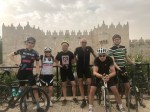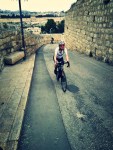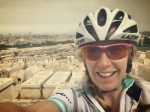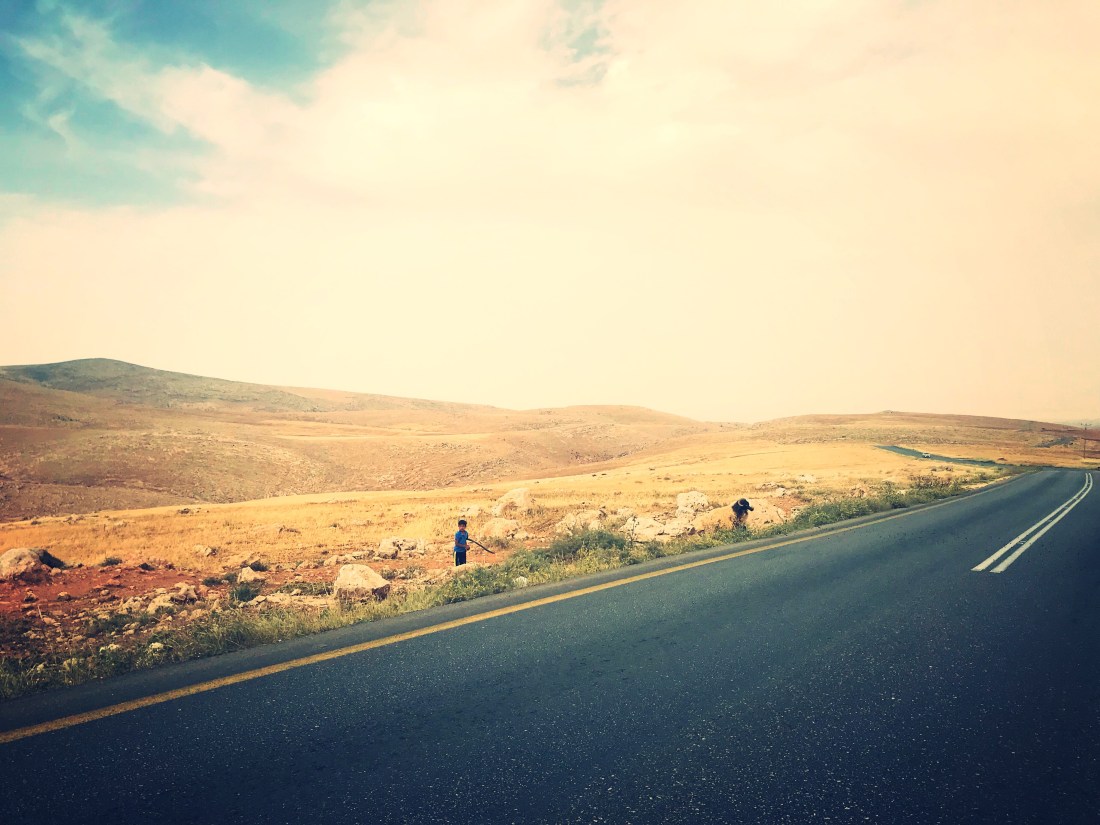
Post #3: Those roads. Those hills. That descent.

Cycling Palestine gave me a real sense of connection to the political geography of the land.  A connection I had not experienced on previous trips to the country.  The man-made tools of occupation or ‘protection’  – barriers, checkpoints, road blocks – stood in marked contrast to the earthy and fertile land.  The shining asphalt of the Israeli engineered roads were a world away from the unpaved dirt tracks that led to many of the small hillside villages.  All were physical representations of the politics that shape how people can or cannot move from place to place around the land.

Palestine is marked by the ‘green line’:  the designated border agreed after the 1947-49 war.  In the 1990’s, the Oslo Accords laid out the deal brokered between the Palestinian Authority and Israel, providing Palestinians with the theoretical right to self government.  The West Bank was divided into three administrative divisions:  Area A, to be exclusively administered by the Palestinian Authority, Area B to be jointly administered by Palestine and Israel and Area C to be administered by Israel (Area C comprises 61% of Palestine and is home to many Israeli settlements) .  Areas A and B were chosen to contain Palestinian population centres.  Area C surrounds them and, in Area C, Israel retained full control over security, civil affairs, planning, building, infrastructure and development.  Our cycle tour took us from Israel, into Area C and in and out of Areas A and B.  The majority of the miles were ridden on land that is designated as Area C.  This is important because it shaped the quality of the rodes we were able to ride on…

On the first day we followed a route from Tel Aviv airport (located on the Mediterranean  just 5 m above sea level) to Jericho (nestled 280m below sea level looking across to the Jordan Valley and the Dead Sea).  Our version of the Coast-to-Coast!  The route swept up and down fantastically smooth and wide roads that connected the city to the Palestinian hills and the towns beyond.  We headed towards Taybeh, a Christian village that is home to Palestine’s most famous brewery.  This was one of the high points of the ride:  literally because it sits at 950m above sea level and symbolically because it marked the beginning of The Descent of the tour.  The 14 mile ride down to Jericho was world class.  Long sweeping roads, little traffic, perfect tarmac and brake pads frying in the heat.  1100m of pure cycling buzz in one hit.  Yes, this nervous descender has been converted (sort of – lets just say I didn’t get any strava cups for my time!).  Where was the Giro?  And what an amazing climb it would be – perhaps best left for another trip during cooler months.

We passed across the Green Line at the start of the day,  just 12 or so miles into the route.  Remarkable that the distance was so small and, all the more so, since the only evidence that we had crossed the ‘border’ was the faint dotted line showing on our Garmin maps.  It was quite a distance further along the road before we saw evidence of checkpoints – a reminder of the subtle ways in which borders can be pushed and territories extended.

We marvelled at the quality of the roads. Much of our route was through Area C.  The incursion of Israeli occupation was evident throughout the area.  Settlements were dotted across the hills and valleys, encroaching on ancient Palestinian land.  The shining roads evidence of the infrastructure in place to provide easy access to the settlers and support development.  We cycled on smooth wide tarmac, with enough room for us to ride safely out of the reach of passing traffic – a world away from Devon lanes.  Even on busier highways there was always room (well, apart from in Jerusalem.  And Nablus).  But, when we had time to take a breath and glance up from the trance like pedalling of the uphill slogs, we would spot the trunk roads that  led to settlements, the guard post in the distance and signs showing a Wolf which seemed to be the settlers mark.  Often there were barriers on the roads, ready to ‘secure’ settlements and cut off access if needed.
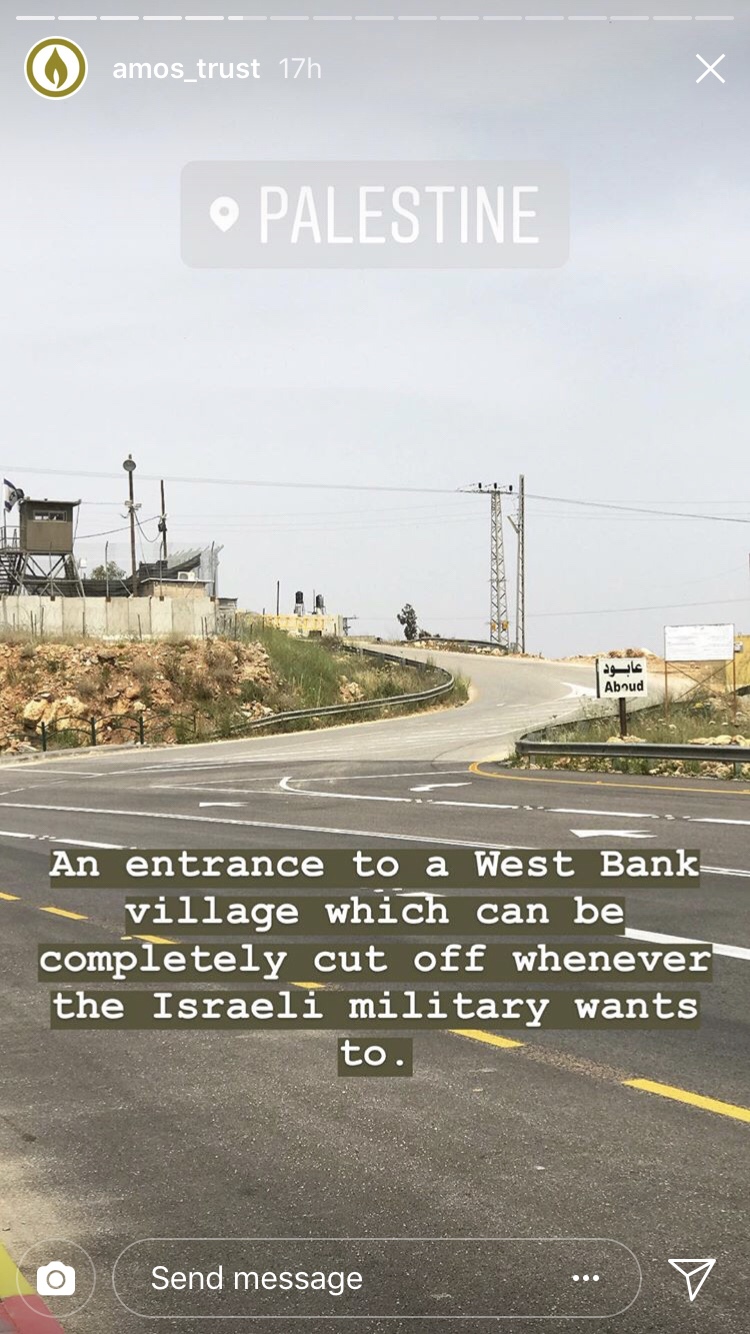
Sometimes the roads that branched off the main roads were unkempt, worn down or downright dust tracks.  These were always roads to Palestinian villages.  Many cut in half by the criss crossing pattern of the settlements and the roads that connect them.  We had heard tales before of villages being cut in half by road developments that the villagers were unable to drive on.  This type of activity just contributes to the gradual wearing down of Palestinians and its hard to see it as anything other than a deliberate act designed to gradually ‘encourage’/force them to leave the land.  Riding through on a bike gave me a real sense of just how much the Palestinian landscape has been shaped and re-shaped by the Israeli government.

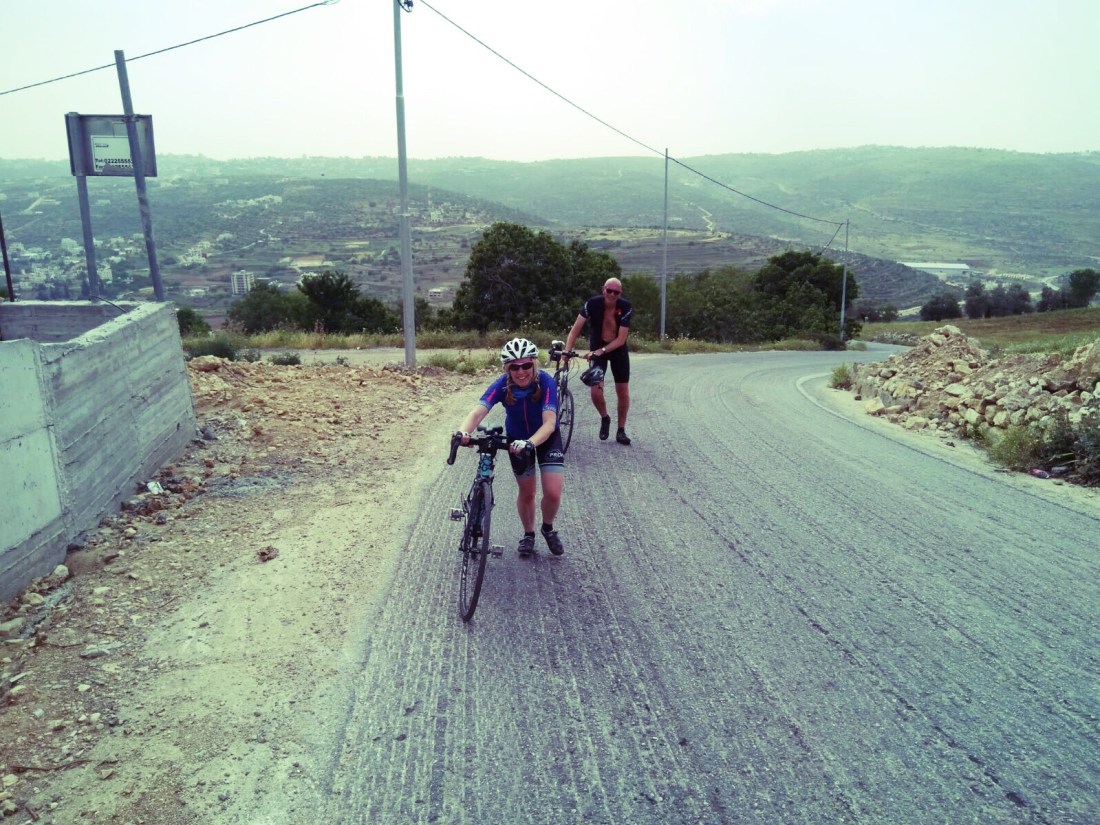
James observed this week that that the steepest and sharpest climbs were often on the poorly maintained roads leading to Palestinian villages.  The longer but more joyous gradual climbs reserved for the highway roads dominated by Israeli cars.  This doesn’t feel like a coincidence.  Gradients as steep as 25% were not uncommon and, on one particularly hot and rough climb, the gradiant stayed at 20%+ for over 900m of narrow, half finished and busy road.  One by one we came off our bikes, the steep terrain too dangerous for us to hold.  Jacs made it the furthest but still bailed near the top as it became impossible to keep her wheels in contact with the tarmac or weave safely from side to side in the manner that was necessary to make the climb achievable.  With cleats and slick road tyres one wrong turn could have been fatal.  Although the slow tottering walk, pushing bikes as we tried not to fall on our tiny cleats, was probably harder in the end!
img_6320

Although we rode mainly in Area C, whenever we approached the towns and villages in Areas A and B we were met with more watchtowers and the imposing red signs that denoted Palestinian presence.  DANGER TO ISRAELI CITIZENS.  Is it any wonder that people have so much fear of the other when signs like these are part of their day to day reality?

We stayed in the larger towns that marked the end points of our daily journeys: to the east, the north and the south.  Jericho was a vibrant town, it felt somewhat isolated and maintained a sunny, outward feel.  Jenin, in the North, is built on fertile land.  The hills and fields are greener and we approached as the villagers were harvesting the cucumber crop.  The city has seen many troubled times and the refugee camp buildings were littered with bullet holes, a stark reminder of the ongoing vulnerability of life for those living in them.  In Bethlehem, Aida Camp was a familiar friend.  Narrow streets, UNWRA schools where the only windows were narrow slits (to avoid bullet fire hitting the children in lessons) and stories of tear gas not letting us forget that this was a refugee camp.  Warm welcomes from the children on the streets and the team at Al Rowwad reminding us that even in the midst of despair humanity can prevail.

Our third ride, from Jenin to Taybeh, took us from the North of the country southwards towards Taybeh and then on to Bethlehem by bus.  The landscape was the most stunning I have seen in Palestine and the 68 mile remains my favourite ride to date.  Ever.

Gentle rolling hills gave way to long sweeping climbs and sudden sharp ascents.  Our first destination was the historic village of San Sebastia, located midway between Jenin and the city of Nablus.   We truly bonded ‘to the land’ when google maps failed us and our route took us up a dirt track and over a mountain path.  Whilst mapping routes is possible using the modern apps available to riders, google maps hasn’t yet fully imaged the Occupied Territories so it was often impossible to see whether smaller roads were rideable or not.  A dusty road became a track, which became a gravel track and then a hike.  A hike with a bike.  Ali, the wonderful driver of our support van, valiently followed us until the gradient became too much for his truck.  He turned back, choosing to take the long road diversion (political geography at work again) to the village where we were heading.  A bemused farmer, tending the olive groves on his small tractor, waved as we hiked past, our bikes slung over our shoulders or pushed out in front.  Forty five minutes or so later the village emerged in the distance – Ali and the van stood with a group of local farmers, ready to greet us and wave us off on the rest of our journey!

We rode on to San Sebastia.  A coffee stop in the village square, with accompanying recorder-playing from an old man and his grandson, and a chance to survey the damage to our cleats.  San Sebastia is associated with the Tomb of John the Baptist and is also the site of the best preserved Roman Ruins in Palestine.  A huge amphitheatre lies beneath the village and some of its columns are visible in the fields below.  Archaelogical excavation has not been possible – archaelogical endeavours a victim of occupation.

The ride from San Sebastia to Nablus was less eventful, but took in genuinely undulating roads that wound through the valleys between the hilltops.  Nablus was steep, busy and hot.  A beautiful city reputed to serve the best Kanafah cake in the world, we stopped only to refuel with falafel from a roadside cafe and then moved quickly on, keen to put some distance between ourselves and the hectic city traffic.  The journey south to Taybeh took in some of the most prolonged and beautiful climbs I think I will ever ride.  In the mid afternoon light, we pedalled upwards, silently working our way to the top of roads that seemed to last for miles.  Peaceful and focused.  We had been warned that the final climb up to Taybeh was hard.  I loved it.  High on adrenalin I found my rhythm.  I even saw some breakaways and catch up attempts nearer the top.  When we reached the turn-off to the village we were jolted out of our cycling high by the presence, once again, of that RED SIGN and the checkpoint guard towers.  We cycled past, aiming for the famous brewery that is at the heart of the town.  In true British style we arrived too late.  It was closed.  We had to settle for a bottle in the local hotel, before jumping in the van for the ride to Bethlehem.

The next day we headed south and into the Hebron Hills.  We were only able to skirt the city of Hebron itself – our bikes would not be able to fit through the narrow turnstiles that mark the checkpoints into the Old City.  Most of us had visited Hebron before and were still haunted by memories of walking down the near empty souks of the Old City, where settlers have moved into building above Palestinian homes in a direct act of harassment and where cordons cut off section off streets and pavements from one another – a large path for the setttlers, a narrow strip for the Palestinians.  Hebron is a depressing reminder of the brutality of the occupation and as we rode out of the suburbs towards the hills we noticed the increased presence of military patrols and cars along the road.  Gav and Jacs spotted a mysterious military vehicle parked on the road, it’s driver filming us as we rode past.  A short time later they were both stopped by a police patrol car and questioned about our activities and destination.  I’ve already written about the situation for the villagers in Al Tawani and the ride there summarised, in a nutshell, the profound experience of cycling through a military occupation in one of the most beautiful lands you can imagine.

So for the cycling fans out there.  Here’s the TP summary of our two big rides.

And if you’re interested to see what the political geography looks like on a map (source Middle East Eye map included in a 2018 article maps from the website (www.palestineportal.org)

Those roads.  Those hills.  That descent.  Doesn’t it make you want to ride here?


Post #2: Beautiful Resitance. Beautiful Palestine.

Yesterday was the 70th anniversary of the Nakba:  the ‘great catastrophe’ when over 700,000 Palestinians fled their homes.  Over half the population were displaced:  forced into refugee camps in Gaza, the West Bank, Jordan, Syria and Lebanon.  Few have returned.  The UN has since passed Resolution 194 calling on Israel to permit Palestinians the right to return.  Yet tented refugee camps have now become permanent suburbs of towns, today inhabited by the families of those who fled in the 1947-49 war.

Nothing has changed.

Social media feeds today are full of pictures of the massacre that took place on Monday, including those now coming through of violence against Palestinians on the West Bank.  Commentators have questioned how could this happen.  Strong, polarised opinions, have been expressed by those on all sides of the ‘debate’.  It is absolutely right that media outlets are reporting on the horrors that are unfolding this week and that the world sits up and pays attention.  By ignoring the problems created by our governments we all become in some way complicit in what is going on.

But I recognise that for many people Palestine just hasn’t isn’t on their radar and that there is a risk that they have seen it, and now will see it, through an incredibly polarised lens.  Day to day experiences of life in Palestine are little reported.  I wonder whether, if we understood more of the daily narrative of life for Palestinians in the West Bank and Gaza, this context may stir us to act more not less?

A friend posted a beautiful response to a facebook comment today, urging the commentator to visit Palestine and see for themselves the situation and the beauty of the people who live there before they passed judgement.  She is right.  So today I’m writing about the people we met on our journey (read:  the boring tourist story bit!).

So I began by thinking about what adjective I’d pick to describe the country.  There’s tons of options and I’m no literary expert.  I’d love to know which one my fellow riders would use.  After the news this week ‘helpless’ might seem appropriate.  But I always come back to ‘beautiful’.  Palestine is not an easy ‘beautiful’.  It’s not an obvious choice when you ride along roads strewn with rubbish (no refuse collections in some areas, little infrastructure in others), littered with plastic debris (environment guardianship is so much easier in countries with relative peace and prosperity) and through villages where half the houses are only part completed (Palestinians save for years to build one floor of a house, then the second and so on…most barely make it beyond the first floor) and some are completely demolished ( a tactic used by the IDF to harass families into leaving their homes and villages).  It’s definitely not a good word to describe a land ensnared by barbed wire fences, checkpoints and a concrete Occupation Wall that entraps and divides communities.

But look beyond that and the country is stunningly beautiful.  Sweeping hill sides, olive groves, ancient pines, deserts, a ‘Dead’ sea, villages perched on the top of hills and cities precariously built sloping down the hills into the valleys below.  More historic sites and holy relics than a pilgrim could visit in a year and a stunning climate to boot.  More importantly,  the Palestinians I met had beautiful souls.  They were warm, welcoming and open to our band of merry cyclists.

What we witnessed through the stories we heard and the people we met were many and varied acts of ‘beautiful resistance’ – non-violent, creative and focused on rebuilding communities and providing opportunities for hope and growth. 

Riding a bike gives you a deep connection with the land through which you travel.  Like walking a dog or pushing a pram, riding a bike in Palestine is the perfect conversation ice breaker.   I am not exaggerating when I say that cycling is a totally undeveloped sport in Palestine.  It’s not just the lack of strava segments (there aren’t many and those we created we ‘own’!) or the absence of clear route maps (google earth hasn’t quite reached the furthest corners of the Holy Land yet).  It was the dawning reality that we were a total novelty for most.  Whoops and cheers of ‘welcome, welcome’ were shouted from children on balconies, men and women in cars beeped their horns at us and people on the streets and shops that lined them came out to say ‘hello’.  Our distinctive pink jerseys (chosen to reflect the pink of the Giro) made us impossible to miss and the addition of two female riders drew much surprise and hilarity.

“Come, come, into the freezer” offered some local butchers as they saw us, one by one, stopping with exhaustion at the top of a particularly steep climb in the heat of the early afternoon sun.  We tottered through the slippery butcher’s shop, past hanging carcasses desperate to enjoy a brief moment of frozen bliss.

“Mechanic, I mechanic” whispered an elderly man who stopped his car half way up another steep hill (steep hills… they feature hugely in our journey) to help me as I tried to un-wedge my chain which had fallen off and become wedged in the big ring.

Watermelons were thrust in our hands by vendors at the top of a road junction.  The melons were displayed comically on a large black leather sofa which had pride of place amongst a cornucopia of bric-a-brac which included a fetching 1980’s stationary bike.  Chris jumped on for photos whilst the rest of us enjoyed the sweet taste of the melon slices.

A gentleman tentatively approached us outside the Church of the Nativity in Bethlehem.  He told us he was a cyclist and had spotted us in our pink jerseys as we cycled the narrow streets of the souk and out into the expanse of Manger Square.  He wanted to share with us his concerns about the Giro and our apparent support for it.  He was beyond delighted (and somewhat relieved) when we told him ours was a ride of solidarity and protest against the Giro, not in support of it!

In Hebron a car swerved in front of us and a smartly dressed salesman jumped out, announcing he was the coach of the Palestinian cycle team.  We asked directions to a coffee shop and he led us to one of his favourites, where he proceeded to tell us about his efforts to create and coach a cycling team (or group?!) in the West Bank.  He shared stories of riding mountain bikes in the hills, where Palestinians and Israelis enjoy relative peace away from the heavily patrolled roads.  He spoke of road rides that crossed checkpoints where soldiers were unable to distinguish them from Irsaeli riders in the lycra uniform of the road cyclist.  He told of his dreams to coach the Palestine team and provide more robust training programmes and better kit (bikes have to be built in Palestine as the cost importing brand bikes via Israel is just too high).  Some of the team had already forged links with cycling groups in France and other countries and a small group had joined a Tour of Brittany the previous year.  He told us that his group of male riders was growing and he even had one or two females in the ‘team’ – bravely challenging traditional female perspectives in the largely Muslim country.

Cycling:  a form of beautiful resistance and a tool to unite and bring people together. 

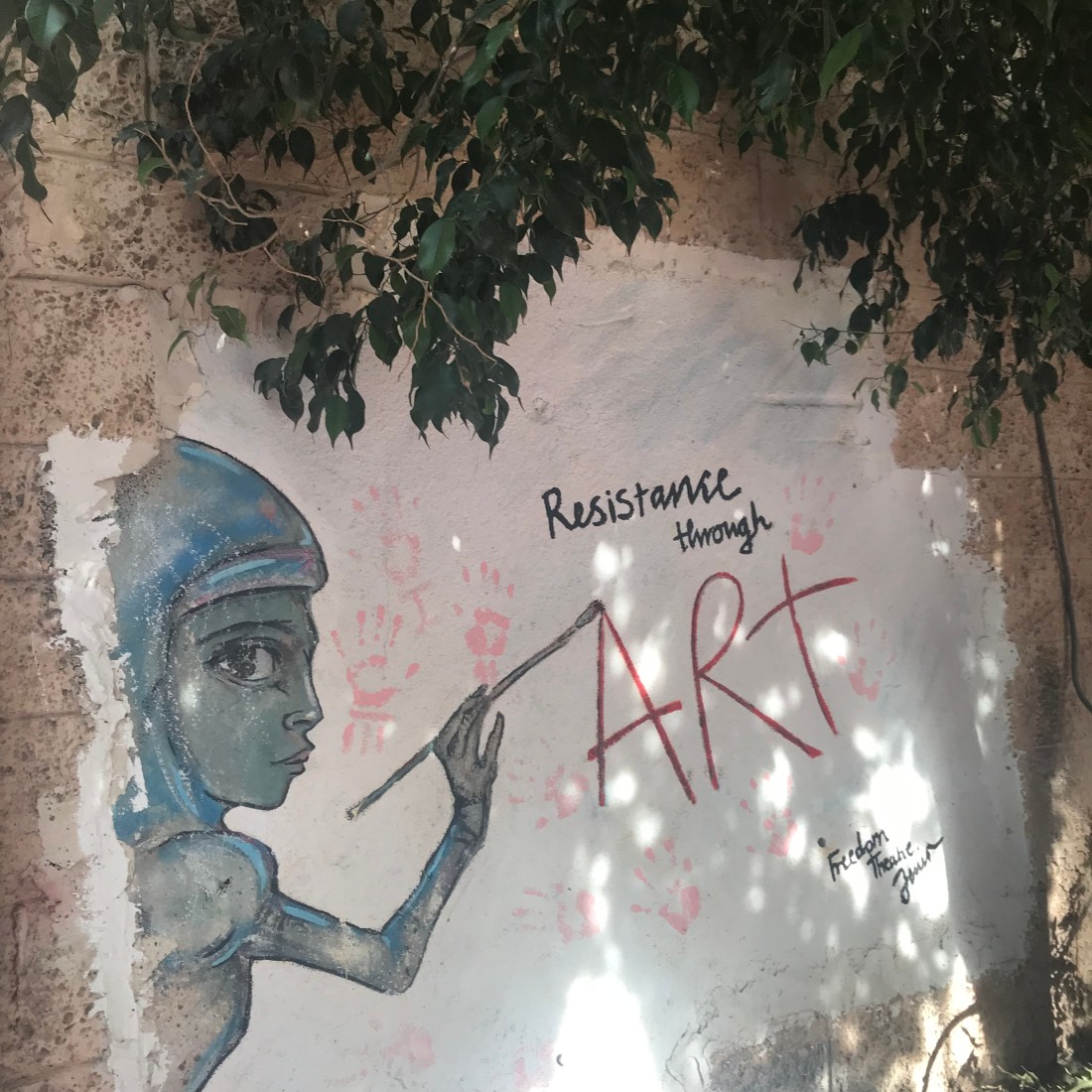
Interwoven with our cycling adventures were the stories of the people we met through the projects Amos Trust supports.  We rode north to Jenin to visit the Freedom Theatre (www.thefreedomtheatre.org).  The theatre grew out of a project set up by Arna Mer Khamis, (a Jewish revolutionary who chose to live and work among Palestinians) to use theatre and art to address the chronic fear, depression and trauma experienced by the children living in the Jenin Refugee Camp.  The theatre, in its original form as The Stone Theatre, was destroyed by Israeli tanks when they invaded the camp in 2002 but has been rebuilt and re-imagined as the Freedom Theatre.  Today it hosts theatre groups, coaches children and stages productions showcasing local and international talent.  The walls of the building are adorned by colour paintings – the most poignant ‘resistance through art’.  Outside in the streets of the camp it was impossible not to notice the bullet holes that danced across the walls of every building we passed.

We rode south to the Hebron Hills to visit the Sumud Freedom Camp at At Tuwani and meet Havez, their Community Leader.  Sat on the floor of the open community building, eating a delicious lunch that appeared from nowhere, we listened as Havez spoke passionately about his vision for the future of his homeland and his community.  At-Tuwani sits at the gateway to the South Hebron hills and the villages beyond which are home to ancient Bedouin communities.  These communities have been dwindling as people leave in the face of increasing encroachment from settlers.  The most ideological of the settlers have chosen the holy sites of Hebron and the surrounding hills as their chosen home despite the fact that land is Palestinian.  Settlers move in with a few tents, the IDF move in to ‘protect’ them, infrastructure is build to support ‘security’ and suddenly you have a whole settler town watching over you.  The Bedouin communities still live in caves, tents and simple dwellings in marked contrast the barbed wire and sophistication of the military apparatus that guards the settlers.  Havez is determined to move beyond violent protest and establish a community stronghold that can support Palestinians to return to their homes in the area and provide education, infrastructure and jobs to enable them to thrive once again.  As the gateway village At Tuwani is the key to creating permance.  If At Tuwani is broken then there is no hope for the villages beyond.  So he showed us the Freedom Camp, the restored cave dwellings, the village well that had been rebuilt and the new shower and toilet area with running water.  Simple projects but all created without the aid of machinery or modern tools – they simply aren’t available to Havez and the families and young students who work with him.

We met two Italian missionaries, living in the Sumud Camp on a three month mission to provide ‘protection’ to the children who attend the school and tend the sheep on the fields and hills.  Some of the settlers are so violent to the children as they walk to school that the IDF have had to provide protection escorts to the Palestinian youngsters.  However they continue the pattern of harassment, often turning up late so the children miss lessons.  The Italians simply walk with the children to and from school each day and then stay with them as they go into the fields.  They’re basically acting as a Human Shield.  A ‘missionary shield’ to stop soldiers and settlers attacking because let’s face it – even the IDF is smart enough to know that images of Italian missionaries being attacked whilst walking with children would not make good media.

We stayed in the wonderful Al Rowwad Guesthouse, part of the Alrowwad Theatre project that Amos has supported for a number of years (www.alrowwad.org).  Al Rowwad is based in Aida Refugee Camp in Bethlehem and provides a centre for art, theatre and photography – a place for those living in the camp to find expression and gain education through the arts.  The new guesthouse project provides income through the accommodation and includes workshop space and a cookery school.  This was my third visit to Al Rowwad and the camp and as I’m writing these reflections I realise that I’ve stolen the phrase beautiful resistance from them!

Looking once again at their website I’ve seen the quote from their mission statement.  A quote that has stuck with me since my first trip to Aida five years ago:

“beautiful resistance against the ugliness of occupation and violence”.

I remember now why I think the word ‘beautiful’ sums up Palestine so neatly.


Post #1: Bethlehem to Jerusalem

Monday 7th May. Amos ‘Giro dell Palestina’ Day 5: Bethlehem to Jerusalem

Monday 14th May 2018. The US embassy moved to Jerusalem: over 50 Palestinians killed and 1000’s injured in the worst day of violence since 2014.

I’m starting at the end.  I’ve rewritten this post multiple times.  And regretted even thinking I could blog on this topic given everything I’ve read in the news this morning and my lack of writing, blogging, journalistic skills.  But here goes…

Following days of blistering heat, we awoke to rumours of thunderstorms and flash floods in the valleys.  Nervous discussion at breakfast focused on whether rounding off our journey with a ride to Jerusalem was important enough to risk potentially slippy and dangerous roads if the weather gods were not kind.  The desire to journey of course won out and we left – somewhat bemused by Chris’s estimate that the short ride (only 15 miles there and back) was going to take us 3 hours or more?

For a second morning, we began by snaking through the tight streets of Aida Refugee camp, which had been our home for the last two nights as we enjoyed wonderful hospitality at the recently opened Al Rowwad Theatre guesthouse (www.alrowwadguesthouse.com).  We were now used to our path being blocked by groups of curious children, happily interrupting their walk to school to chat and welcome us, some even trying to wrestle our bikes and have a go on our shiny machines.  Curiosity about our band of pink lycra-clad riders was a constant and joyous feature of our trip through Palestine.

Out of the camp, we climbed the steep hill to one of the checkpoints that separate Bethlehem from the Israeli controlled area and Jerusalem beyond.  We had hit rush hour and a long queue of cars and buses had already built up along the narrow street.  Weaving in and around them required all my concentration as I worried about the risk of falling as I rode, clipped in, on steep hills at very slow speed (note to self – bike handling skills need a bit of work!).   We passed through the checkpoints without event – our UK passports a ticket to a relatively easy crossing.  For most Palestinians the checkpoints are a dramatic visual and practical symbol of the occupation.  They mark the boundaries of freedom – travel beyond requires papers, permission and often long, long queues.  The long concrete walkways designed to ‘manage the flow of people’ through the checkpoints were a stark reminder that for many Palestinians, if they do have permission to travel or work on the other side, their journey is likely to be a long and painful one.

The ride to Jerusalem was just 6 or 7 miles.  The suburbs sprawled giving the impression that the city is almost conjoined to Bethlehem.  But in that short distance the whole feel of our journey changed.  With a sudden jolt we were away from sweeping but quiet highways and winding rural roads and were twisting and turning through the heavy rush hour traffic in the city.  With every pedal turn I felt like we were moving further away from the warmth and openness of Palestine into a city that, but for the sun (that had decided to ignore the weather forecasters) and historic streets, was like any other Western city I might ride through.  The streets became more sterile, houses and buildings more pristine, green areas were greener and the infrastructure more efficient.  In the largely Israeli areas gone were the water tanks on the roofs and rubbish on the streets – both giveaway signs of Palestinian populated areas, denied access to regular delivery of basic municipal services such as refuse collection, water and electricity supply.  Car horns beeped us to get out of the way rather than to celebrate our uniqueness and acknowledge our crazy journey.   It was like being back in London, everyone with their heads down focused on their daily commute, children being rushed to school by their parents.  Bizarrely the more ‘western’ the streets the more dangerous they felt.  More cars, more tour buses and the combination of steep ascents and descents to navigate at the same time!  How ironic that the most ‘danger’ I felt was not from a Palestinian terrorist or IDF gun but the day to day nightmare of city traffic.

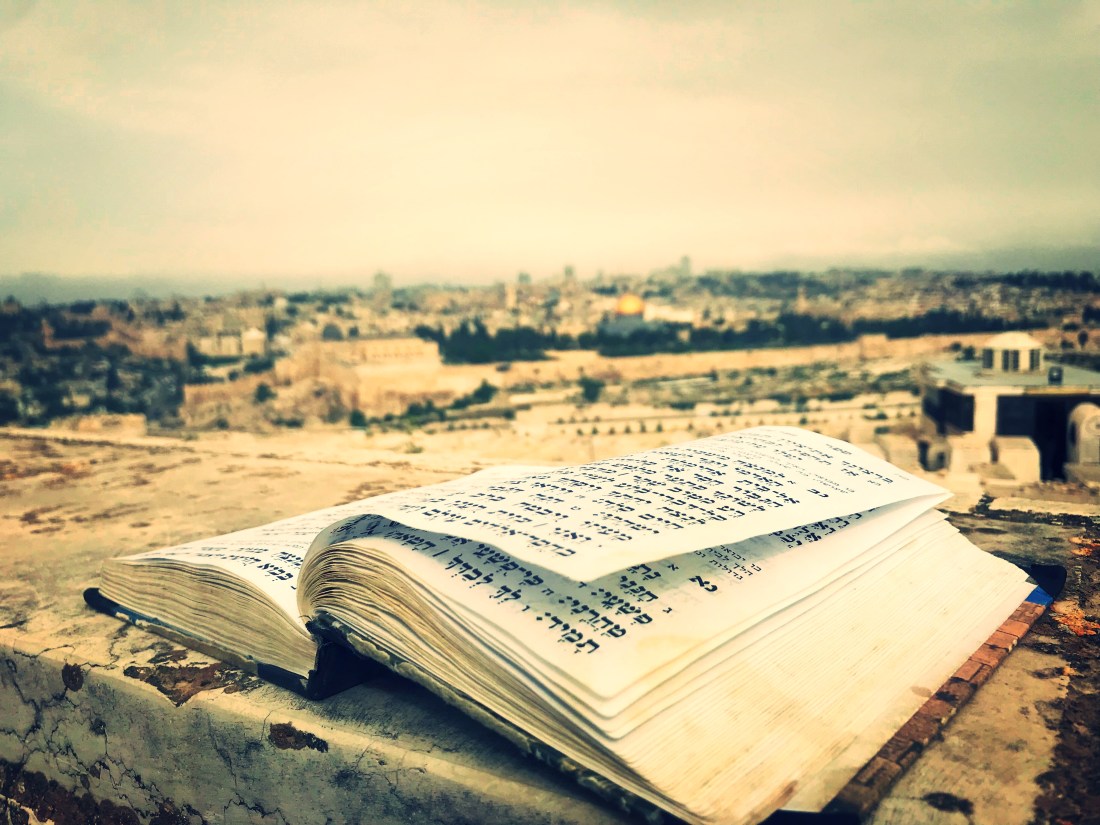
Cycling up (and down) the steep hills of the Old City was a privilege and worth the hair raising ride. It would have been wrong not to visit the city given its position at the centre of so many of the issues relating to the Palestinian situation.  Our destination was the Mount of Olives for some needed time of reflection and peace (together with the hundreds of other pilgrims doing the same!).  We navigated the ridiculously steep climb to top (bagging a few Strava cups on the way), choosing the narrow road that later in the day would be filled with pilgrims and tourists walking down to the Garden of Gethsemane below.  Thank goodness we didn’t encounter any on the way up!  When we reached the top we spotted a copy of the Torah resting on a wall overlooking the Jewish cemetery below.  It’s pages were blowing gently in the wind that blew across from the old city where the golden roof of the Dome of the Rock shone brightly in the early morning sun.  Stillness and peace for a moment:  a chance to reflect on the possibility of calm and rest for all those caught up in this seemingly unsolvable situation.

Jerusalem is a sacred city for Muslims, Jews and Christians.  Palestinians and Israelis both claim it as their desired capital.  In 1948 the UN designated the city as a special international zone but during the 1948 war Israel took control of the western half of the city and in the 1967 Arab-Israeli conflict they seized control of the eastern half from Jordan.  Palestinian political leaders still consider East Jerusalem to be the home of their future capital.  The ‘green line’ snakes through the city and the areas which are still home to Palestinians have a very different feel.  It is estimated that as much as 40% of the city’s population are Palestinians but they are crowded into small areas in East Jerusalem and surrounding refugee camps where there is little municipal interest in investment in building, infrastructure and basic services.  How must it have felt when the Giro circus rode into day a few days earlier, staging the exciting time trial event in the city’s old streets, to know that the propaganda circus would once again whitewash the reality of life in Jerusalem for some many of its residents?

Reality from reflection.  One of our group ‘lost’ his bike to a throng of Japanese tourist jostling for photos and the predicted storm clouds were gathering rapidly over the hills.  We departed as the tourist rolled in and the rush hour traffic subsided.  Our return cycle was calmer, providing more opportunity to witness the changing urban geography around us.  The relief was palpable when we returned to the familiarity of Bethlehem.  Our route took us around part of the Occupation Wall – a section decorated with slogans, art work and messages of support for the Palestinian people.  The final destination of our trip was the Walled Off Hotel, curated and set up by the artist Banksy as a homage to Palestine and its people.  We took some time to visit the hotel museum which captured perfectly the Palestinian/Israeli situation and conveyed with empathy, loving wit (and an ability to shock around every corner) the reality of life under occupation.  The stories with the most impact for me were the ones that touched on daily life – not dramatic protest or Intifada, just stories of how a visit to hospital can be delayed by checkpoint security, how children can be harassed on the streets, camps raided daily, how water supplies can be cut off for hours on end for no apparently reason.  There is real hope that the hotel (and the Banksy connection) will provide another touch-point for people visiting Israel to learn more about life behind the Occupation Wall.  We spoke to a lovely couple who were staying at the hotel because they loved Banksy, they had no idea about the Palestinian situation and their visit to the museum had moved them such that they wanted to find out more and journey deeper into the country.

So fast forward one week.   Yesterday the US actually moved it’s embassy to Jerusalem – there could not be a clearer message from the Trump Administration that it recognises Jerusalem as the de facto capital of Israel.  The timing of the move coincided with the 70th anniversary of Israel’s declaration of Independence (May 14th 1948) and the 70th anniversary of the Nakba ‘the great catastrophe’ (May 15th 1948) that saw over 700,000 Palestinians, more than half their population, displaced from their homes and forced to flee to refugee camps in the West Bank, Gaza, Jordan, Lebanon and Syria).  It’s hard not to see it as deliberately inflammatory.  Is it any surprise that Palestinian’s have been protesting each Friday for some weeks now and that yesterday saw some of the largest protests to date.  The Palestinians we met universally advocated peaceful resistance (for some that was part of the the journey through violent protest to find a more positive way to express and fight for hope).  But, when you face daily harassment and denial of the most basic of human rights, when you have no hope and you see Israel and the West stoking the fire with such an insensitively timed piece of public pageantry, is it any surprise that you feel desperate for your voice to be heard.  Where is the equality of voice?  There’s no doubt that among the protesters in Gaza there will be some that advocate violence.  But the vast majority of men, women and children are desperate simply to have their voice heard.  Facing them are snipers and tanks from one of the best equipped defence forces in the world, taking indiscriminate fire at people in the name of security.  Where is the balance in the that?

The media is often accused (by me included) of biased reporting.  But yesterday every media source I read in the UK was clear about one thing:  over 50 Palestinians died and over 1,000 were injured, many of them women and children, in what was the worst day of violence in years.  Israeli forces fired indiscriminately at those gathering at the border in Gaza.   Depending on your media of choice you may then have gone on to read that the Palestinian protesters were terrorists, that they were proud to be martyrs or maybe that Israel has the right to defend itself against attack.  Or, perhaps you read that the might of the IDF rained bullets on protesters without discrimination whilst 50 away the leaders of the free world sat in all their pageantry celebrating an event which almost certainly has escalated the current tensions and made the likelihood of any peace process even more tenuous.

One week ago we arrived home jubilant and buoyed from our trip to the West Bank and Jerusalem.  This week is hard not to be plunged into despair.