Monday 7th May. Amos ‘Giro dell Palestina’ Day 5: Bethlehem to Jerusalem
Monday 14th May 2018. The US embassy moved to Jerusalem: over 50 Palestinians killed and 1000’s injured in the worst day of violence since 2014.
I’m starting at the end. I’ve rewritten this post multiple times. And regretted even thinking I could blog on this topic given everything I’ve read in the news this morning and my lack of writing, blogging, journalistic skills. But here goes…
Following days of blistering heat, we awoke to rumours of thunderstorms and flash floods in the valleys. Nervous discussion at breakfast focused on whether rounding off our journey with a ride to Jerusalem was important enough to risk potentially slippy and dangerous roads if the weather gods were not kind. The desire to journey of course won out and we left – somewhat bemused by Chris’s estimate that the short ride (only 15 miles there and back) was going to take us 3 hours or more?
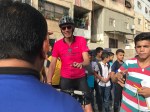
For a second morning, we began by snaking through the tight streets of Aida Refugee camp, which had been our home for the last two nights as we enjoyed wonderful hospitality at the recently opened Al Rowwad Theatre guesthouse (www.alrowwadguesthouse.com). We were now used to our path being blocked by groups of curious children, happily interrupting their walk to school to chat and welcome us, some even trying to wrestle our bikes and have a go on our shiny machines. Curiosity about our band of pink lycra-clad riders was a constant and joyous feature of our trip through Palestine.


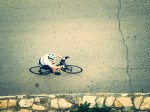
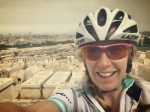
Out of the camp, we climbed the steep hill to one of the checkpoints that separate Bethlehem from the Israeli controlled area and Jerusalem beyond. We had hit rush hour and a long queue of cars and buses had already built up along the narrow street. Weaving in and around them required all my concentration as I worried about the risk of falling as I rode, clipped in, on steep hills at very slow speed (note to self – bike handling skills need a bit of work!). We passed through the checkpoints without event – our UK passports a ticket to a relatively easy crossing. For most Palestinians the checkpoints are a dramatic visual and practical symbol of the occupation. They mark the boundaries of freedom – travel beyond requires papers, permission and often long, long queues. The long concrete walkways designed to ‘manage the flow of people’ through the checkpoints were a stark reminder that for many Palestinians, if they do have permission to travel or work on the other side, their journey is likely to be a long and painful one.
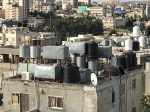
The ride to Jerusalem was just 6 or 7 miles. The suburbs sprawled giving the impression that the city is almost conjoined to Bethlehem. But in that short distance the whole feel of our journey changed. With a sudden jolt we were away from sweeping but quiet highways and winding rural roads and were twisting and turning through the heavy rush hour traffic in the city. With every pedal turn I felt like we were moving further away from the warmth and openness of Palestine into a city that, but for the sun (that had decided to ignore the weather forecasters) and historic streets, was like any other Western city I might ride through. The streets became more sterile, houses and buildings more pristine, green areas were greener and the infrastructure more efficient. In the largely Israeli areas gone were the water tanks on the roofs and rubbish on the streets – both giveaway signs of Palestinian populated areas, denied access to regular delivery of basic municipal services such as refuse collection, water and electricity supply. Car horns beeped us to get out of the way rather than to celebrate our uniqueness and acknowledge our crazy journey. It was like being back in London, everyone with their heads down focused on their daily commute, children being rushed to school by their parents. Bizarrely the more ‘western’ the streets the more dangerous they felt. More cars, more tour buses and the combination of steep ascents and descents to navigate at the same time! How ironic that the most ‘danger’ I felt was not from a Palestinian terrorist or IDF gun but the day to day nightmare of city traffic.


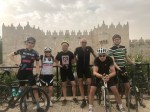
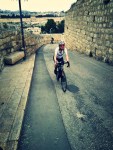
Cycling up (and down) the steep hills of the Old City was a privilege and worth the hair raising ride. It would have been wrong not to visit the city given its position at the centre of so many of the issues relating to the Palestinian situation. Our destination was the Mount of Olives for some needed time of reflection and peace (together with the hundreds of other pilgrims doing the same!). We navigated the ridiculously steep climb to top (bagging a few Strava cups on the way), choosing the narrow road that later in the day would be filled with pilgrims and tourists walking down to the Garden of Gethsemane below. Thank goodness we didn’t encounter any on the way up! When we reached the top we spotted a copy of the Torah resting on a wall overlooking the Jewish cemetery below. It’s pages were blowing gently in the wind that blew across from the old city where the golden roof of the Dome of the Rock shone brightly in the early morning sun. Stillness and peace for a moment: a chance to reflect on the possibility of calm and rest for all those caught up in this seemingly unsolvable situation.
Jerusalem is a sacred city for Muslims, Jews and Christians. Palestinians and Israelis both claim it as their desired capital. In 1948 the UN designated the city as a special international zone but during the 1948 war Israel took control of the western half of the city and in the 1967 Arab-Israeli conflict they seized control of the eastern half from Jordan. Palestinian political leaders still consider East Jerusalem to be the home of their future capital. The ‘green line’ snakes through the city and the areas which are still home to Palestinians have a very different feel. It is estimated that as much as 40% of the city’s population are Palestinians but they are crowded into small areas in East Jerusalem and surrounding refugee camps where there is little municipal interest in investment in building, infrastructure and basic services. How must it have felt when the Giro circus rode into day a few days earlier, staging the exciting time trial event in the city’s old streets, to know that the propaganda circus would once again whitewash the reality of life in Jerusalem for some many of its residents?
Reality from reflection. One of our group ‘lost’ his bike to a throng of Japanese tourist jostling for photos and the predicted storm clouds were gathering rapidly over the hills. We departed as the tourist rolled in and the rush hour traffic subsided. Our return cycle was calmer, providing more opportunity to witness the changing urban geography around us. The relief was palpable when we returned to the familiarity of Bethlehem. Our route took us around part of the Occupation Wall – a section decorated with slogans, art work and messages of support for the Palestinian people. The final destination of our trip was the Walled Off Hotel, curated and set up by the artist Banksy as a homage to Palestine and its people. We took some time to visit the hotel museum which captured perfectly the Palestinian/Israeli situation and conveyed with empathy, loving wit (and an ability to shock around every corner) the reality of life under occupation. The stories with the most impact for me were the ones that touched on daily life – not dramatic protest or Intifada, just stories of how a visit to hospital can be delayed by checkpoint security, how children can be harassed on the streets, camps raided daily, how water supplies can be cut off for hours on end for no apparently reason. There is real hope that the hotel (and the Banksy connection) will provide another touch-point for people visiting Israel to learn more about life behind the Occupation Wall. We spoke to a lovely couple who were staying at the hotel because they loved Banksy, they had no idea about the Palestinian situation and their visit to the museum had moved them such that they wanted to find out more and journey deeper into the country.


So fast forward one week. Yesterday the US actually moved it’s embassy to Jerusalem – there could not be a clearer message from the Trump Administration that it recognises Jerusalem as the de facto capital of Israel. The timing of the move coincided with the 70th anniversary of Israel’s declaration of Independence (May 14th 1948) and the 70th anniversary of the Nakba ‘the great catastrophe’ (May 15th 1948) that saw over 700,000 Palestinians, more than half their population, displaced from their homes and forced to flee to refugee camps in the West Bank, Gaza, Jordan, Lebanon and Syria). It’s hard not to see it as deliberately inflammatory. Is it any surprise that Palestinian’s have been protesting each Friday for some weeks now and that yesterday saw some of the largest protests to date. The Palestinians we met universally advocated peaceful resistance (for some that was part of the the journey through violent protest to find a more positive way to express and fight for hope). But, when you face daily harassment and denial of the most basic of human rights, when you have no hope and you see Israel and the West stoking the fire with such an insensitively timed piece of public pageantry, is it any surprise that you feel desperate for your voice to be heard. Where is the equality of voice? There’s no doubt that among the protesters in Gaza there will be some that advocate violence. But the vast majority of men, women and children are desperate simply to have their voice heard. Facing them are snipers and tanks from one of the best equipped defence forces in the world, taking indiscriminate fire at people in the name of security. Where is the balance in the that?
The media is often accused (by me included) of biased reporting. But yesterday every media source I read in the UK was clear about one thing: over 50 Palestinians died and over 1,000 were injured, many of them women and children, in what was the worst day of violence in years. Israeli forces fired indiscriminately at those gathering at the border in Gaza. Depending on your media of choice you may then have gone on to read that the Palestinian protesters were terrorists, that they were proud to be martyrs or maybe that Israel has the right to defend itself against attack. Or, perhaps you read that the might of the IDF rained bullets on protesters without discrimination whilst 50 away the leaders of the free world sat in all their pageantry celebrating an event which almost certainly has escalated the current tensions and made the likelihood of any peace process even more tenuous.
One week ago we arrived home jubilant and buoyed from our trip to the West Bank and Jerusalem. This week is hard not to be plunged into despair.

 Giro Della Palestina: Palestine by Bike!